
Introduction
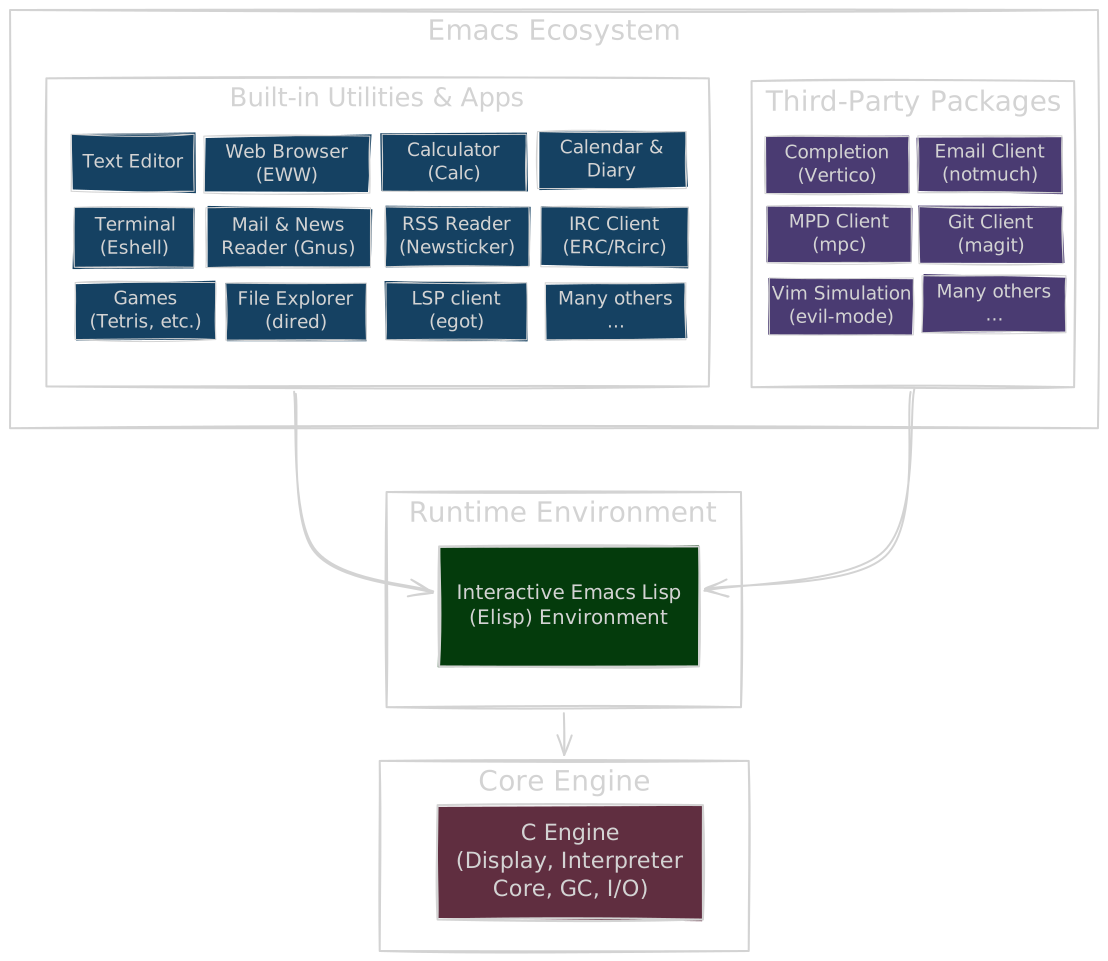
Calling Emacs simply a text editor is like calling Windows a text editor just because it happens to ship with Notepad. At its core, Emacs is an interactive Emacs Lisp (Elisp) environment layered on top of a C engine. On top of this runtime environment, an entire ecosystem is built: a text editor, web browser, calculator, calendar, mail and news reader, RSS reader, IRC client, Tetris game, and countless other utilities. While all of these tools come built into Emacs out of the box, the community has also created thousands of third-party packages using that very same environment.
Emacs is best described as an extensible, self-documenting, and primarily keyboard-driven computing environment:
Extensible: Virtually all built-in tools, workflows, and core components can be customized or entirely replaced.Self-documenting: All the help and reference material you need is available directly insideEmacs. You can explore, inspect, and learn Emacs using its own introspection tools.Keyboard-driven: While mouse support is available, Emacs is designed to be driven entirely by the keyboard. Investing in a good ergonomic split keyboard and learning touch typing is very rewarding.
This section might seem boring at first, but understanding Emacs terminology is essential. It clarifies how Emacs is structured, making it far easier to master its commands and navigate its documentation.
Emacs was developed in the 1970s and it predates modern graphical desktop conventions by more than a decade. Its vocabulary can feel counterintuitive to newcomers used to modern operating systems. To bridge that gap, this guide maps Emacs terms to their counterparts in VSCode.
Note: These comparisons help you understand the terminology, but you should adopt native Emacs terminology by calling components by their proper names which will make manuals and community tutorials much easier to follow.
Frame
A Frame is an independent operating system window. Just as you can open multiple VSCode windows across different monitors, you can spawn multiple Emacs Frames across your screens.
Window
An Emacs Window is a pane inside a Frame. Just as you can split your VSCode editor area into vertical or horizontal panes to view different files side by side, you can split an Emacs Frame into multiple Windows.
Buffer
A Buffer is an in-memory object containing text or binary data. You can think of it as an open file/tab inside VSCode.
Emacs buffers fall into three primary categories:
- File-Visiting Buffers: Associated with persistent files on disk, such as source code files and notes.
- Process Buffers: Driven by underlying system processes, such as terminal emulators and compilation outputs.
- Internal Buffers: Utilities maintained directly by Emacs, typically named with surrounding asterisks (such as
*scratch*for Elisp scratchpads and*Messages*for runtime logs).
Mode Line
A Mode Line is a status bar displayed at the bottom of every Emacs Window. It functions like the status bar in VSCode, reporting diagnostics such as modification state, current line number, and file encoding. Unlike VSCode's single global bar, every active window in Emacs has its own dedicated Mode Line.
Echo Area
The Echo Area is a single-line output display at the bottom of the Emacs Frame. It displays short status updates, error alerts, and function output, serving a purpose similar to the bottom output or notification panel in modern editors.
Minibuffer
The Minibuffer is an interactive prompt at the bottom of the frame that activates whenever Emacs needs user input. It functions similarly to VSCode's Command Palette, prompting for commands, file names, or search queries.
Major Mode
Every buffer has exactly one Major Mode active at any time. It governs fundamental behaviors including syntax highlighting, indentation rules, and language-specific keybindings like Python mode, Rust mode, and Org mode.
Minor Mode
Minor Modes are modular, optional features layered on top of the active major mode. Multiple minor modes can run concurrently in a single buffer, providing granular functionality such as line numbers, on-the-fly spell checking, and auto-saving.
Discovery and Completion
I still remember very well the first time I downloaded and ran Emacs back in 2008. I'm certain I said something along the lines of, "Meh, this definitely isn't my type of text editor." Out of the box, Emacs is plain and confusing for newcomers, it also has a steep learning curve. However, there is a good reason so many developers stick with it and treat it almost as a way of life, there simply is no other tool that offers what Emacs provides.
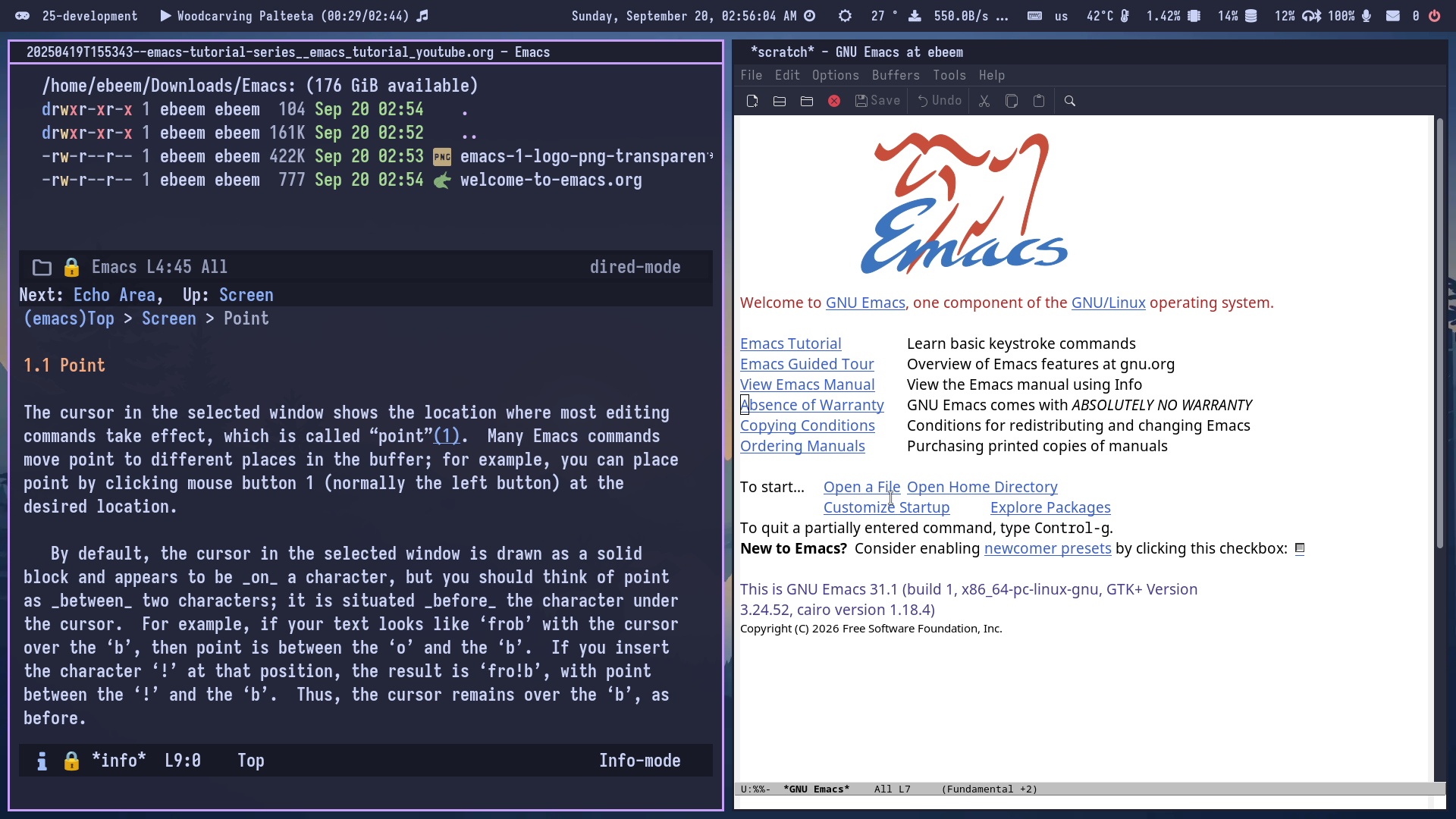
I prepared a minimal helpful starter kit. For now, do not worry about the Lisp syntax or how every detail works under the hood. We will break down package management and configuration step by step in future articles. The goal right now is simply to give you a polished and modern environment.
Locating Your Configuration File
Emacs stores its user configuration in a file called init.el. If this file does not exist yet, you can create it in the following locations depending on your operating system:
- Linux & macOS:
~/.emacs.d/init.elor~/.config/emacs/init.el - Windows:
%APPDATA%/.emacs.d/init.el(typicallyC:/Users/<Username>/AppData/Roaming/.emacs.d/init.el)
Open or create init.el, replace its contents with the configuration below, and restart Emacs. If the file was loaded successfully, you will notice your Emacs became dark themed.
;;; init.el --- Minimal configuration for Emacs 30+ -*- lexical-binding: t; -*-

;;; Package management
(require 'package)
(add-to-list 'package-archives '("gnu" . "https://elpa.gnu.org/packages/") t)
(add-to-list 'package-archives '("nongnu" . "https://elpa.nongnu.org/nongnu/") t)
(add-to-list 'package-archives '("melpa" . "https://melpa.org/packages/") t)
(package-initialize)

(require 'use-package)

;;; typography
(set-face-attribute 'default nil
                    ;; :family "Iosevka" ;; Uncomment and set your preferred font
                    :height 160       ;; Font size (1/10 pt, e.g., 160 = 16pt)
                    :weight 'regular)

;;; theme
(use-package modus-themes
  :ensure t
  :config
  (load-theme 'modus-vivendi-tinted :no-confirm))

;;; which-key: in-buffer keybinding cheat sheet (built-in starting in emacs 30)
(use-package which-key
  :ensure nil
  :init
  (which-key-mode 1))

;;; vertico: vertical minibuffer completion ui
(use-package vertico
  :ensure t
  :init
  (vertico-mode 1))

;;; orderless: out-of-order space-separated fuzzy pattern matching
(use-package orderless
  :ensure t
  :custom
  (completion-styles '(orderless basic))
  (completion-category-defaults nil)
  (completion-category-overrides '((file (styles partial-completion)))))

;;; marginalia: contextual annotations in minibuffer margins
(use-package marginalia
  :ensure t
  :init
  (marginalia-mode 1))

;;; sensible ui defaults
(setq inhibit-startup-screen t)
(menu-bar-mode -1)
(tool-bar-mode -1)
(scroll-bar-mode -1)

;;; init.el ends here
What's Next?
Understanding the separation between frames, windows, buffers, and modes establishes a solid foundation for everything that follows.
In Part 2: User Input & Text Navigation, we explore the Emacs input hierarchy, modifier chords, and motion primitives.